
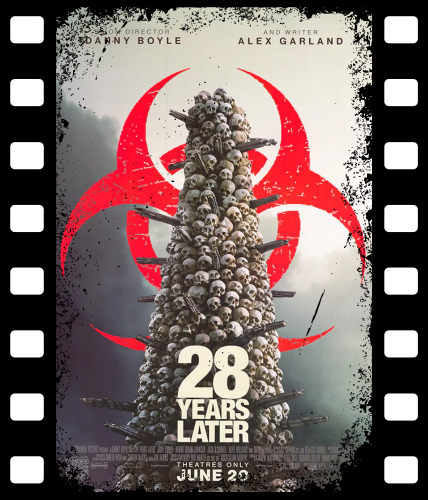
Movie Details
Directed by:
Danny Boyle
Written by:
Alex Garland
Produced by:
Andrew Macdonald / Peter Rice / Bernie Bellew / Danny Boyle / Alex Garland
Starring:
Jodie Comer / Aaron Taylor-Johnson / Alfie Williams (in his feature film debut) / Ralph Fiennes
Genre(s):
Drama / Horror
Release Year:
20 June 2025
Where to Watch:
HBO Max / Amazon Prime / Apple Tv / YouTube
Running time:
115 Minutes
💡Why It Caught My Attention
It is the third installment of the 28 Days Later franchise, which I am a fan off.
Zombie-like monsters, a post apocalyptic world, rite of passage, a quest for survival in the wild… nuff said.
📌Plot
A group of survivors of the rage virus live on a small island. When one individual of the group leaves the island on a mission into the mainland, he discovers secrets, wonders, and horrors that have mutated not only the infected but other survivors.
🔥 Worth the Hype?
“I don’t know…”
That is what I immediately answered myself after watching the movie.
As the credits rolled up I expected a post scene or something that could better answer the question of…
“What did I just watched?”
As in many other films I wish to review soon, I am a big fan of this franchise. Although the second installment wasn’t as good as the first one, it was decent and it added to the lore of this particular universe.
Does 28 Years Later stand up to them and the hype? Let’s find out, shall we?
🎥 Expectations and First Impression
Before diving into the review itself, I want to briefly touch on something I already talked about in my very first post on this site, where I went into more detail about how I ended up rediscovering this franchise.
Let me add a little context so you can understand my state of mind at the time.
One morning I woke up and went through the usual rituals… you know the drill.
Eventually I found myself in front of the TV and opened YouTube to reconnect with the world…
…yeah, I know it’s weird that I use that platform that way instead of going outside and having proper conversations.
Anyway, while browsing the recommended videos on my homepage, I saw a familiar logo that instantly brought back an amazing experience from years ago in the horror genre.
It was the biohazard symbol.
But this time it wasn’t the classic black icon on a red background. This one was blood red, with “28 Years Later” written in white on top of it.
“Oh shit…!”
That was my immediate reaction.
Goosebumps flared all over my body. I couldn’t have been more excited at that moment—a third movie was finally on the way.
Then I noticed the release date of the trailer.
It was almost five months old!
Was I really that disconnected from my most beloved genre that I discovered a sequel to a great franchise only weeks before the actual release date?
The easy answer is… well, yeah. I was.
The why, however, is a bit more complicated. As I explained in that first post, where I talked about falling out of love with modern horror films, I had grown increasingly disappointed with the recent wave of horror movies and slowly distanced myself from the genre for a while.
There were a few exceptions I could still mildly enjoy… Talk to Me (2023), Barbarian (2022), Nope (2022), Late Night with the Devil (2023), Evil Dead Rise (2023) and Malignant (2021), but after some time I simply drifted away from Hollywood horror.
Instead, I started reading more, catching up on some works from Stephen King and discovering authors like John Katzenbach and Sebastian Fitzek.
And honestly, I had a great time.
But eventually curiosity got the better of me, and I started checking upcoming horror releases again. Long story short… that’s how I ended up discovering the trailer so late.
And that moment reminded me of something important:
I had always been a great fan of this franchise.
The cherry on top was the rumor that Cillian Murphy might return to this universe. Of course, that sent me down the rabbit hole searching for everything I could about the film… except the cast details or the plot. I wanted to keep at least a few surprises intact.
Let me tell you… I was genuinely excited. So much so that I decided to make it the first horror movie I would watch after my long break from the genre.
My return to my favorite genre.
🎭 What it made me think and feel
From the very first image I got a jump scare… and not the kind the movie intended. Ever since I was very young, the Teletubbies have always given me the creeps… so seeing them appear on screen immediately triggered that old childhood discomfort.
Then came a pleasant surprise: the film shows a short scene from the very beginning of the contagion. It’s a great, action-packed sequence where the infected (often referred to as “Rage Zombies” since the first installment) make quick work of the people in a small community.
The Rage Virus, in my opinion, produces some of the most terrifying zombies in cinema. Infection happens almost instantly, and the victims retain all their physical capabilities… sometimes even enhancing them. They are fast, aggressive, and completely rabid.
In that opening chaos, we see a young boy forced to flee after his mother sacrifices herself while his father remains inside the church, seemingly accepting—or even welcoming—what is happening outside. The kid’s quick instinct to run made me think he might end up being the main character of the film… maybe even the hero of the story.
Moments like that also made me reflect on something a bit more serious. We really need to take better care of our society. Mental health should be taken much more seriously in this day and age. Giving positions of influence or authority to unstable people can be reckless, and situations like the one portrayed in the film highlight how dangerous blind belief can be.
Anyway, the next scene shifts dramatically in tone… and visually, it’s beautiful. We see a small island community, which honestly feels like the perfect base for a post-apocalyptic setting.
Through this setting we learn that the UK mainland has been devastated, while most of Europe managed to contain the virus. Britain has essentially been left isolated, forced to deal with the consequences on its own.
With the world pushed back into survival mode, people have returned to activities that are almost extinct in modern urban life: hunting, gathering, and basic survival skills. It’s an interesting concept, because many of us today have slowly forgotten how to take care of ourselves outside of modern conveniences.
Personally, I wouldn’t even know where to start.
How do you build a proper fire for cooking?
How do you clean an animal after a hunt?
How do you find safe drinking water?
Today we simply walk to the nearest convenience store… or order food from our phones.
After 28 years of survival, you’d expect that some extraordinary individuals would emerge from that environment. Heroes… and probably villains too.
I won’t go too deeply into certain plot details for the small group of readers who might be reading this before watching the film, but one particular moment made me reflect on how dependent modern society has become on medication, hospitals, and constant medical supervision just to maintain everyday life. Remove all of that, and many of us (especially those of us used to city living) would struggle to survive for long.
The pacing of the film also gave me the feeling that this world truly exists decades after the original movie, rather than feeling like a direct continuation of the sequel. Maybe it’s the photography, the atmosphere, or the visual tone, but it felt closer in spirit to the first film.
Once the story reveals who the real focus of the plot is, the movie starts to feel less like a pure survival horror film and more like a coming-of-age story. The main character appears to be the young boy Spike, who travels to the mainland with his father for the first time in order to scavenge and prove himself.
The song “Boots” by Young Fathers adds a very eerie and unsettling tone to the film, a vibe I already loved when I first heard it in the trailer.
Another interesting addition to the lore is the introduction of Alpha infected, suggesting that the virus has evolved and produced different kinds of infected over time. Expanding the world in this way is one of the movie’s most intriguing ideas.
It took me a while to get to the point, but in the end 28 Years Later left me with mixed feelings. I walked away with some unmet expectations… and, oddly enough, a craving for something with a little more meat on the bone.
Don’t get me wrong… it’s a decent movie.
It just wasn’t everything I hoped for as the first horror film in my return to the genre.
However, learning that a sequel was filmed back-to-back and is scheduled to release as early as January 2026 gives me some hope. Maybe this film is only the first half of a larger story; something similar to how It (2017) or Harry Potter and the Deathly Hallows (2010) split their narratives into two parts.
And if that’s the case, the next installment might deliver the payoff this one was setting up.
🎬Direction, Acting and Production
I was genuinely happy to see that the original creative team returned for this installment. Director Danny Boyle and writer Alex Garland, who worked together on the previous films in the franchise, came back for 28 Years Later. In many long-running franchises, a change in director or writer often leads to a noticeable drop in quality, so having them return felt like a very good sign.
What surprised me the most is that I didn’t initially realize how much of a fan I already was of their work. I had only seen a couple of Boyle’s films outside this franchise—The Beach (2000) and Sunshine (2007)—both of which I loved. Then it hit me: those films were also collaborations between Boyle and Garland.
Garland’s work on Dredd (2012), as well as the films he directed himself—Ex Machina (2014) and Annihilation (2018)—are also movies I greatly enjoyed.
So naturally, my expectations were pretty high. And to be fair, the movie is good. But as I mentioned earlier, the biggest issue for me might simply be time constraints. The film left me wanting more, and that ended up being my main source of dissatisfaction.
In fact, 28 Years Later might belong to a category I jokingly call:
“This Would Probably Work Even Better as a Long TV Series.”
The road to this movie was also incredibly long. Ever since 28 Weeks Later (2007), there had been attempts to develop a third installment. After nearly twenty years of rights issues and budget problems, it’s honestly impressive that the project finally became a reality.
One production detail that fascinated me is that parts of the movie were filmed using an iPhone 15 Pro Max, along with action cameras, drones, and a mix of digital and film cameras. It sounds unusual, but the result is actually impressive. The lightweight equipment allows for dynamic shots and movement that often place the viewer right in the middle of the chaos.
In a way, it also feels like a spiritual callback to the original 28 Days Later (2002), which famously used the Canon XL-1 digital camcorder. That camera allowed the filmmakers to move quickly and capture the eerily empty locations of London within tight filming windows.
The locations used in 28 Years Later work extremely well. The environments feel abandoned, hostile, and unforgiving… exactly the kind of world where survival would be incredibly difficult.
The makeup, effects, and costume design also add a strong sense of realism to the infected and the overall setting.
As for the performances, Aaron Taylor-Johnson delivers a strong performance. At times he even made me genuinely dislike his character… which is probably the point. The young actor playing Spike was also impressive. You can really feel the character’s recklessness and inexperience, and the dynamic between father and son carries many of the film’s emotional moments.
And then there’s the Alpha infected.
Damn… that was quite an experience.
The idea of more evolved infected adds an interesting layer to the worldbuilding… although I could probably live without the… dangling anatomical details.
Overall, the technical aspects of the film (direction, acting, production design, and atmosphere) are all solid. Everything works.
Which is why my main frustration isn’t about quality.
It’s simply that I wanted more.
Still, knowing that this movie is only the first entry in a new trilogy gives me hope that the next installments will expand the story and deliver the payoff this film is setting up.
🧩 What Worked
Several elements of 28 Years Later work really well and remind you why this franchise became so influential in the first place.
First of all, the return of Danny Boyle and Alex Garland was a huge win for the film. Their creative vision is one of the reasons the original movie stood out from the countless zombie films that came before it. Their style once again delivers a gritty and grounded atmosphere that makes the world feel believable and dangerous.
The worldbuilding is another strong point. Seeing how the United Kingdom has been left isolated while the rest of Europe managed to contain the virus adds an interesting geopolitical layer to the story. The idea that survivors have spent almost three decades adapting to a harsh and primitive lifestyle is fascinating. Hunting, scavenging, and living in isolated communities makes the setting feel authentic and gives the film a unique survivalist tone.
Visually, the movie also delivers some impressive moments. The decision to use lightweight digital cameras (including the surprising use of an iPhone 15 Pro Max) creates dynamic shots that place the viewer right in the middle of the action. In many ways it feels like a modern evolution of the raw filming style used in 28 Days Later, which relied heavily on digital cameras as well.
The infected themselves remain some of the most terrifying creatures in the genre. The Rage Virus still produces zombies that are brutally fast, aggressive, and relentless. Watching how quickly the infection spreads and how violently the infected behave keeps the tension high whenever they appear on screen.
One of the most interesting additions to the lore is the introduction of Alpha infected, suggesting that the virus has evolved over time and created different types of infected.
Expanding the mythology in this way adds new possibilities for the future of the franchise.
The performances also deserve credit. Aaron Taylor-Johnson brings intensity to his role, and the young actor Alfie Williams playing Spike does a great job portraying a reckless and inexperienced kid trying to prove himself in a brutal world. Their dynamic gives the story some emotional weight and helps anchor the coming-of-age aspect of the narrative.
Finally, the atmosphere and music help maintain the unsettling tone the franchise is known for. The use of “Boots” by Young Fathers adds an eerie and haunting energy that perfectly matches the bleak setting.
🪓 What Didn’t Work
Despite all its strengths, 28 Years Later didn’t completely deliver the experience I was hoping for.
The biggest issue for me was the pacing and overall scope of the story. While the film sets up several interesting ideas, it often feels like it stops just when things are starting to get truly exciting. Instead of feeling like a full, satisfying chapter in the saga, it sometimes feels more like the first half of a larger story.
That might not be entirely accidental. Since the filmmakers already shot another installment back-to-back and plan to release it soon, this movie occasionally feels like it’s mainly focused on setting up the next chapter rather than standing completely on its own.
Another aspect that might divide viewers is the film’s tone. At times it leans more toward a coming-of-age story than a full-blown survival horror experience. While that perspective is interesting, it might not satisfy viewers who were expecting something closer to the relentless intensity of the original film.
I also felt that some of the fascinating concepts introduced, like the evolving infected and the long-term survival of isolated communities, could have been explored more deeply. The world is rich with possibilities, but the movie only scratches the surface.
And that leads back to my main frustration: the film left me wanting more substance. Not necessarily more action, but more development of the ideas and themes it introduces.
None of this makes 28 Years Later a bad movie. It’s still a solid entry in the franchise with strong direction and compelling worldbuilding. But as my first horror movie after a long break from the genre, I was hoping for something a little more complete.
The good news is that this is only the beginning of a new trilogy. If the next installment builds on the foundations laid here, the story could grow into something much bigger and more satisfying.
💬 Personal Takeaway
Watching 28 Years Later felt a bit like reconnecting with an old friend after being apart for a long time. This franchise was one of the reasons I am still in love with horror in the first place, so returning to this universe carried a certain emotional weight for me.
For years I had slowly drifted away from the genre. Many of the newer horror movies simply didn’t resonate with me the way they used to, and I eventually turned my attention to other things… like reading more novels and catching up on authors I had neglected for years. In a way, horror movies had stopped feeling exciting.
So when I stumbled upon the trailer for 28 Years Later, it felt like a small spark reigniting that old interest.
Watching the film reminded me why this franchise has always stood out. The concept of the Rage Virus, the brutal speed of the infected, and the bleak survivalist world it creates still feel unique even today. There’s something about this universe that makes the apocalypse feel raw and immediate.
I think the recent global pandemic just add to it even more.
At the same time, the movie also left me with a strange mix of emotions. On one hand, I enjoyed returning to this world and seeing how it had evolved after so many years. On the other, I couldn’t shake the feeling that the story was only just beginning when the credits started to roll.
In a way, that might be the best way to describe my experience with 28 Years Later: it reminded me why I love horror, but it also made me realize how much I still want from the genre.
And maybe that’s not such a bad thing. If this film is only the first step in a new chapter for the franchise… and perhaps even for my own return to horror, then I’m curious to see where things go next.
📝 Final Verdict / Recommendation
I would definitely like to watch more work from this director and writer in the near future. Their collaboration has produced some truly memorable films, and even with my mixed feelings about certain aspects of 28 Years Later, their creative vision is still something I respect and enjoy.
If anything, this movie actually made me wish the story had been told as a television series rather than a single film. The world they’ve created has enormous potential to explore different characters, communities, and perspectives within this devastated version of Britain. With more time, the story could dive deeper into the themes of survival, isolation, and how society rebuilds itself after decades of catastrophe.
That said, the film is still absolutely worth watching, especially for fans of the franchise and for anyone who enjoys post-apocalyptic horror. The atmosphere, the evolving mythology of the infected, and the strong direction make it a solid entry in the series.
And who knows… depending on how the upcoming sequel expands the story, 28 Years Later might even earn a place in the Top 100 Horror Movies of All Time list I’m planning to put together soon.
🍿My Score: 7.5 (Popcorn out of 10)
Scoring System
Story (0–1)
✅ Coherent and logical plot
✅ Satisfying structure (beginning → middle → end)
Characters (0–1)
✅ Distinct personalities (not just clichés)
❌ Meaningful development or purpose
Acting (0–1)
✅ Performances feel believable
❌ Emotional delivery works
Direction & Decisions (0–1)
✅ Scenes feel intentional (not random)
✅ Creative choices support the story
Immersion (0–1)
❌ World feels consistent (Almost, after so many years you haven’t detected an evolution?)
❌ Doesn’t break its own rules
Pacing (0–1)
❌ No dragging sections
✅ No rushed or skipped moments
Entertainment (0–1)
✅ Holds attention
✅ Delivers engaging moments
Originality (0–1)
✅ Brings something fresh
✅ Avoids overused tropes (or improves them)
Impact (0–1)
✅ Memorable scenes or moments
✅ Emotional or thematic weight
Re-watch Value (0–1)
✅ Worth revisiting
✅ Would you recommend it to someone
📌CTA
I’d love to hear your thoughts on 28 Years Later. Did it meet your expectations? Were there moments that scared, surprised, or upset you?
Feel free to leave your comments, share your perspectives, or even respectfully debate some of the choices made in the film.
I always enjoy reading different points of view.
Thank you for taking the time to read my shenanigans. I appreciate your support, and I hope you found my insights at least, entertaining.
I’ll be back soon with another review or deep dive into a new or old movie, maybe other types of media too.
—From a horror movie fan,
Joe Diaz